 Frequently Asked Questions Frequently Asked Questions

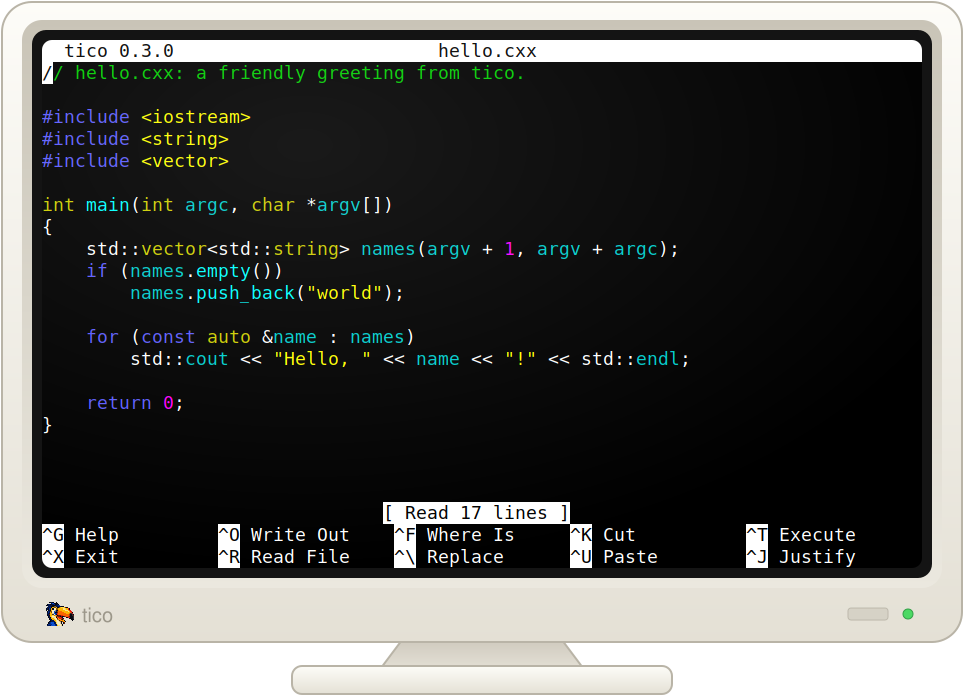
Nano is a great editor, and I recommend using it if you are happy with it. I used to use pico (companion of the Pine e-mail client, later the Alpine project) for many years, and was happy to find nano as an advanced version of that. Tico is my attempt to address what I see as its shortcomings:
Syntax highlighting in nano is not good. You can configure it with regex definitions and colors in your configuration, but these do not give a good result, especially for dynamic languages like Perl (which I work with often). Tico takes a more opinionated approach, using tree-sitter grammars internally. What you lose is some individual configurability, but what you gain is better accuracy. Tico also supports embedded languages, so heredocs containing HTML or another language get the HTML highlighting.
Nano keeps removing features. They recently removed support for Mac Classic format text files. This is quite defensible in 2026, since classic Mac OS was discontinued a couple of decades ago. For me it is kind of annoying though, because I work with vintage systems (including an old Mac Plus which uses such text files), and I am not sure how its removal benefits anyone.
Tico handles file changes on-disk more gracefully. If the buffer hasn't been modified and the on-disk copy changes, tico will reload it. If the buffer has been modified, it will allow you to load the new version, keep your changes, or merge the two. This is the sort of capability that has been available in modern IDEs for many years.
There are some reasons you might want or need to keep using nano:
Nano is a much smaller, lightweight executable.
Nano is a more mature project.
I consider the language tico is written in to be an implementation detail, and you shouldn't need to think about it very much as a user. If one day it makes sense to reimplement tico in another language, I am all for it. There are some benefits to using Rust, which is why I chose it:
tico16 is tico for 16-bit MS-DOS. It is a separate, much smaller program, written in C rather
than Rust, that brings tico's screen layout and nano-style keys to anything from an original 8088 IBM PC up. It
does the essentials: moving around, typing, cutting and pasting lines, and saving DOS, Unix and Mac text files
without changing their format. It's a single 30 KB TICO.EXE, meant as a friendlier replacement for EDIT when
you need to change CONFIG.SYS.
The name tico comes from nano's predecessor pico, which was short for PIne COmposer. I just changed the p to
a t. It doesn't mean anything, but it is just as short as either pico or nano.
Most people pronounce pico /ˈpiːkoʊ/ (PEE-koh), like the SI prefix (as in picosecond) or the "pico" in pico de gallo.
Since pico is short for PIne COmposer, though, I think it should be pronounced with a long "i" as in "pine":
/ˈpaɪkoʊ/ (PIE-koh).
tico isn't short for anything, but like pico (the way I say it), it is pronounced with a long "i":
/ˈtaɪkoʊ/ (TIE-koh).
Yes, as with all birds, Tico is a dinosaur.